 Book assessment
Southern Colorado’s Only Certified USR Speed Lab
Speed
Lab.
Measure it. Train it. Prove it.
Objective speed testing, individualized coaching, and national performance benchmarks for athletes who want more than generic drills.
CertifiedUSRSpeed LabColorado Springs
The COR1 difference
Speed isn’t just something you have.
It’s something you train.
Most athletes are told to “run faster” without ever learning what limits their speed. COR1 replaces guessing with a repeatable system: assess the athlete, identify the opportunity, train the right qualities, and prove what changed.
As Southern Colorado’s only certified Universal Speed Rating Speed Lab, COR1 connects local coaching with a national speed-development system used to organize athlete data, compare meaningful benchmarks, and guide better training decisions.
Powered by Universal Speed Rating
A national system.
A local advantage.
Universal Speed Rating is a speed testing and analytics platform created for performance coaches. Certified Speed Labs use standardized testing, shared benchmarks, athlete profiles, and continuing coach education to make speed development more measurable.
Learn about Universal Speed Rating ↗The four pillars of athletic speed
Game speed is more than a 40.
Each pillar answers a different performance question. Together, they reveal why one athlete wins the first step, another creates separation at top speed, and another changes direction more effectively.
Acceleration
Measures how quickly an athlete builds speed in short spaces. Training targets projection, first-step power, rhythm, and horizontal force.
Max Velocity
Measures true top-end speed. Training develops upright mechanics, front-side action, timing, stiffness, and efficient force application.
Change of Direction
Measures the ability to decelerate, control force, redirect, and reaccelerate—qualities that show up constantly in field and court sports.
Explosive Power
Measures how rapidly an athlete produces force. Strength, jumping, plyometrics, and sprinting are developed as one connected system.
Stop guessing. Start assessing.
The COR1 Speed Lab assessment.
COR1’s five-part profile measures the qualities that influence how an athlete accelerates, reaches top speed, produces force, and changes direction. Testing is coached and standardized so repeat results are meaningful.
Max velocity
Fly 10
The athlete uses a 30-yard build-up before the final 10 yards are timed. The result is converted to miles per hour to capture top-end speed.
Acceleration
Fly 5–10
A five-yard build-up followed by a timed 10-yard segment shows how effectively the athlete creates speed in a shorter distance.
Vertical power
Vertical Jump
Profiles explosive vertical output and provides another view of the athlete’s ability to produce force quickly.
Horizontal power
Broad Jump
Measures horizontal force production—a quality closely connected to projecting the body during acceleration.
Change of direction
Pro Agility
The 5-10-5 shuttle measures braking, directional control, and the ability to reaccelerate efficiently.
The COR1 Speed Development System
Testing is the start—not the finish.
Objective timing and performance data establish the baseline. The real value comes from turning those results into clear training priorities, coaching the athlete, and proving what changed.
- 01
Test
Establish a reliable baseline across the qualities that matter for the athlete.
- 02
Analyze
Identify the athlete’s strengths, limiting qualities, and highest-value training priorities.
- 03
Train
Develop acceleration, max velocity, change of direction, strength, and power with individualized coaching.
- 04
Retest
Revisit key measures, evaluate the response, and adjust the next training phase.
- 05
Perform
Connect improved physical qualities to the movement and decision-making demands of sport.
Coaching in action
Coach speed—not just effort.
Drills are selected to solve a specific movement problem, then connected to high-quality sprinting. Technique, strength, plyometrics, and exposure to speed work together.
Why the profile matters
One system. Clear value for everyone.
See progress and compete with purpose.
Athletes can understand their strengths, chase measurable goals, and connect daily training to results they can see.
Know what the training is doing.
Objective baselines and progress reports create transparency around the plan, the priorities, and whether training is moving the needle.
Make better training decisions.
Testing exposes the quality limiting performance and helps COR1 adjust programming based on evidence instead of assumption.
Measured progress
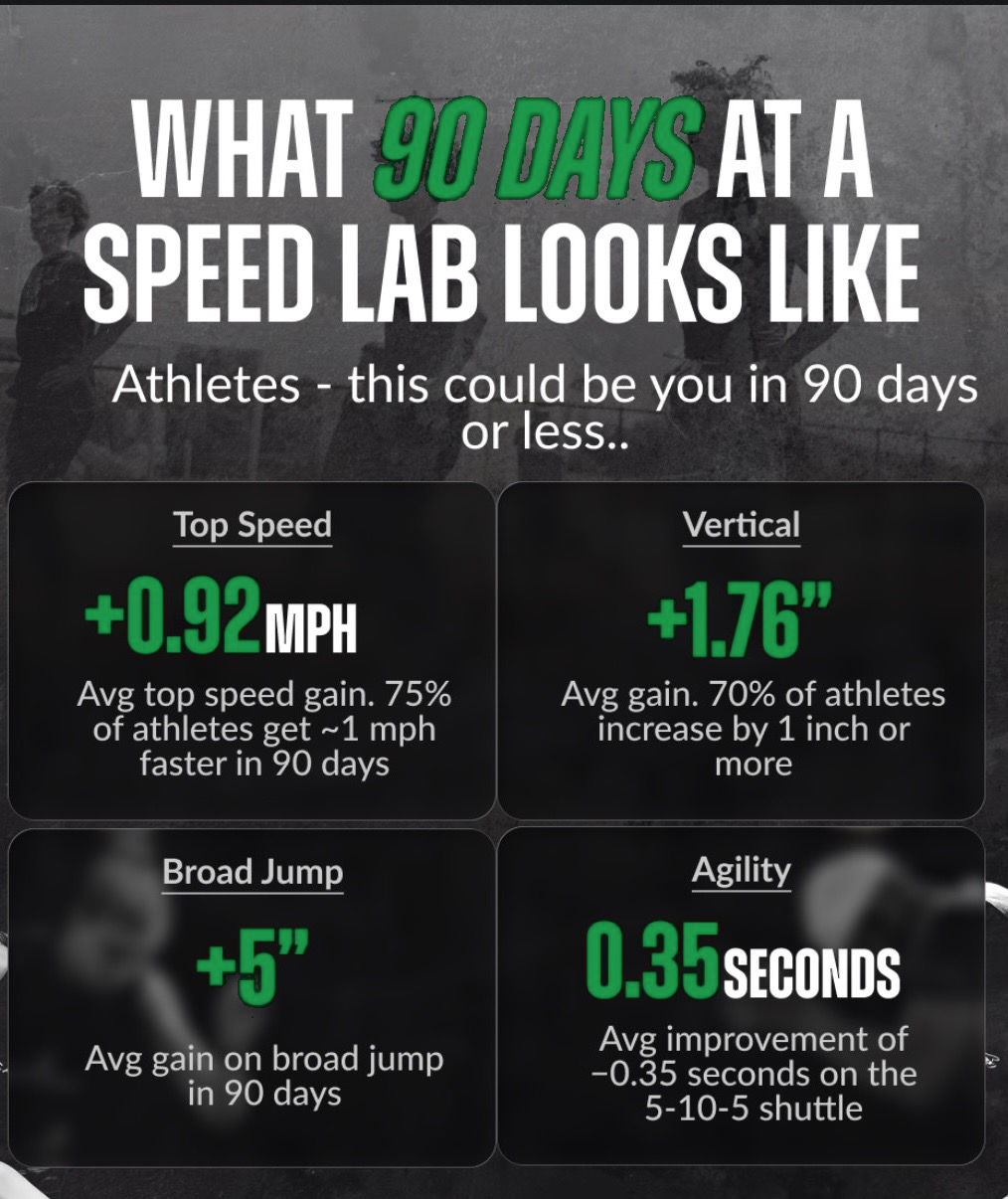
What focused training can change.
These confirmed COR1 averages reflect athlete improvements measured across 90 days of Speed Lab training. Individual results vary based on age, starting point, attendance, training history, and sport schedule.
Who Speed Lab is for
Built for athletes who want an edge.
- Middle school and high school athletes developing foundational speed
- Field and court athletes who need a faster first step
- Athletes who have never received true sprint coaching
- Athletes who want objective speed, power, and agility data
- Healthy return-to-sport athletes rebuilding high-speed exposure
- Teams that want standardized performance testing and development
Frequently asked questions
Questions about the COR1 Speed Lab.
01What makes a Speed Lab different from regular speed training?+
A certified Speed Lab combines qualified coaching with standardized assessment, an organized analytics platform, national benchmarks, and ongoing education. COR1 can show what is changing and use the data to adjust training instead of relying only on observation.
02What is the Universal Speed Rating?+
The Universal Speed Rating is a verified performance framework built around max velocity, acceleration, change of direction, and power. It gives athletes context for where they stand and identifies the qualities most likely to improve their overall speed profile.
03Will my athlete receive a profile?+
Yes. COR1 athletes receive an individual performance profile that organizes their testing results, highlights strengths and opportunities, and creates a clear roadmap for training and retesting.
04How often are athletes retested?+
COR1 uses planned retesting to evaluate whether training is working. Depending on the athlete and program, key measures may be revisited approximately every 30 days while larger profile reviews follow a useful development interval.
05Is Speed Lab only for track athletes?+
No. The system is especially useful for soccer, football, basketball, volleyball, lacrosse, softball, and other sports where athletes must accelerate, create separation, close space, brake, and change direction.
06How often should my athlete train speed?+
For many middle school and high school athletes, two to three focused exposures per week can be appropriate. The right dose depends on practices, games, training age, recovery, and goals. Quality and recovery matter more than simply adding sessions.
Start with COR1
Find out what is limiting your speed.
Start with a Speed Lab assessment and leave with an individual profile, clear priorities, and a roadmap to become faster.